
GPT-5 Astra got a lot better at reconstructing parametric models in FreeCAD. We have spent the past year documenting how far frontier models fall short on geometry, so when a new one lands we run it through the same drill: hand it a dumb solid, ask for an editable feature tree, and compare against ground truth.
This time the first results were suspicious. We tried Astra on a set of open-source models and it scored 100% on everything. Perfect reconstructions, every time. The models are public, so we thought they were almost certainly in the pre-training data.
Finding files that have never been seen before
So we went looking for assemblies that could not be in anyone's training corpus: four real engineering models from private sources, spanning very different scales and geometry.
- Nuclear reactor fuel assembly — a long, slender bundle of rods with a perforated end fitting.
- Mechanical mounting assembly — a cast bearing housing with a bolted bracket.
- Drone body — thin-walled sheet geometry with ribs, tabs, and fastener holes.
- SKF SY 40 FM bearing unit — a pillow block with an inserted bearing and end cap.
We gave Astra each assembly in two formats and asked it to rebuild the model as a parametric FreeCAD document.
A vector image
A topological representation with defined faces and edges. The surfaces are described analytically, so there is structure for the model to read.
A pixelated JPEG
A mesh: thousands of little triangles covering the surface. Every edge and curve has to be inferred from a soup of facets.
Reconstruction results
We scored each reconstruction two ways: geometric similarity to the ground-truth solid, and feature tree quality, which measures whether the parametric history is sensible and editable rather than a single lump of imported geometry.
STEP comes out ahead, as you would expect: with faces and edges already defined, the reconstruction is closer to translation than inference. But the STL numbers are the surprising ones. Going from a bare triangle mesh to an editable feature tree at 86% geometric fidelity is something no model could do a year ago.
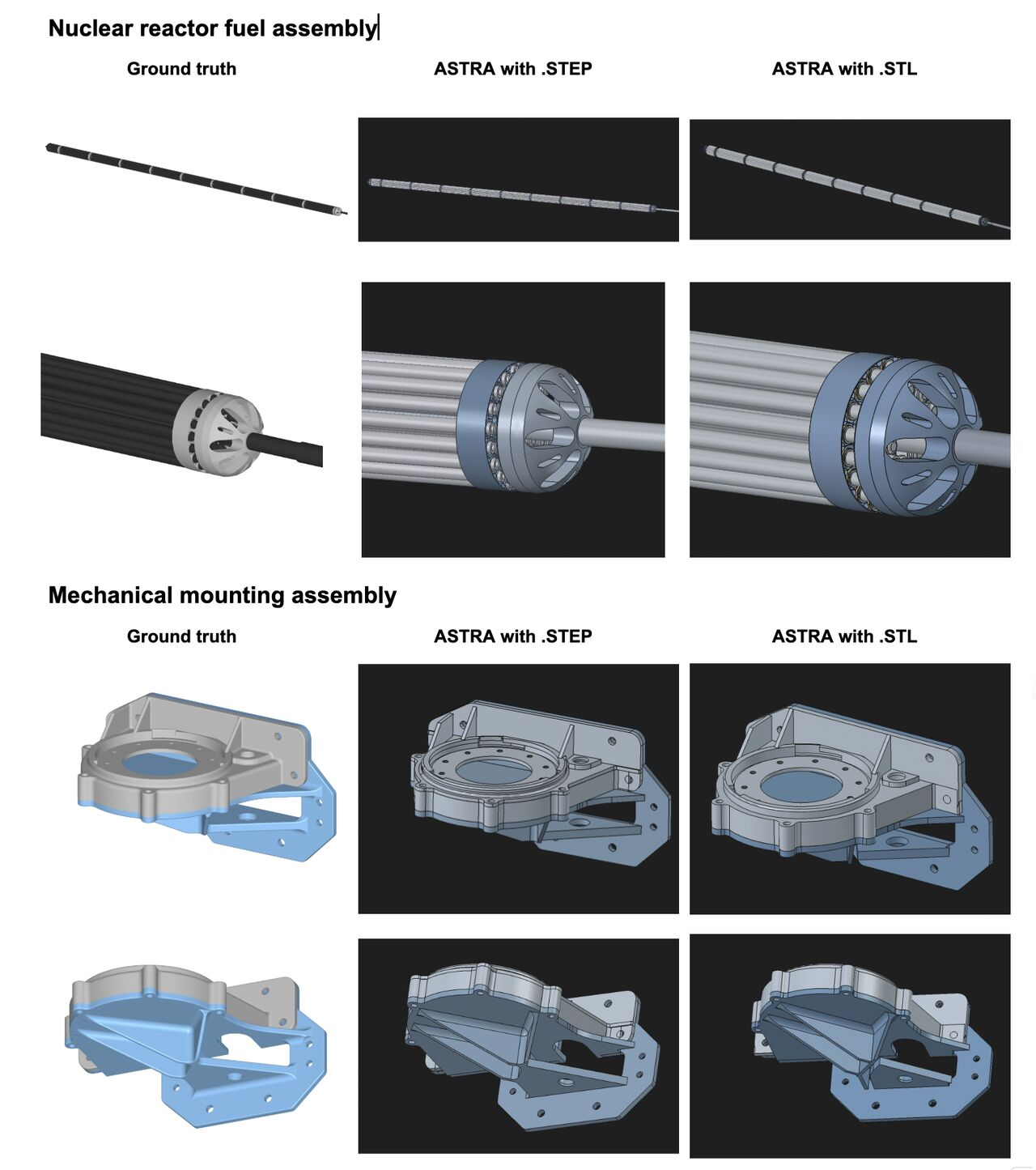
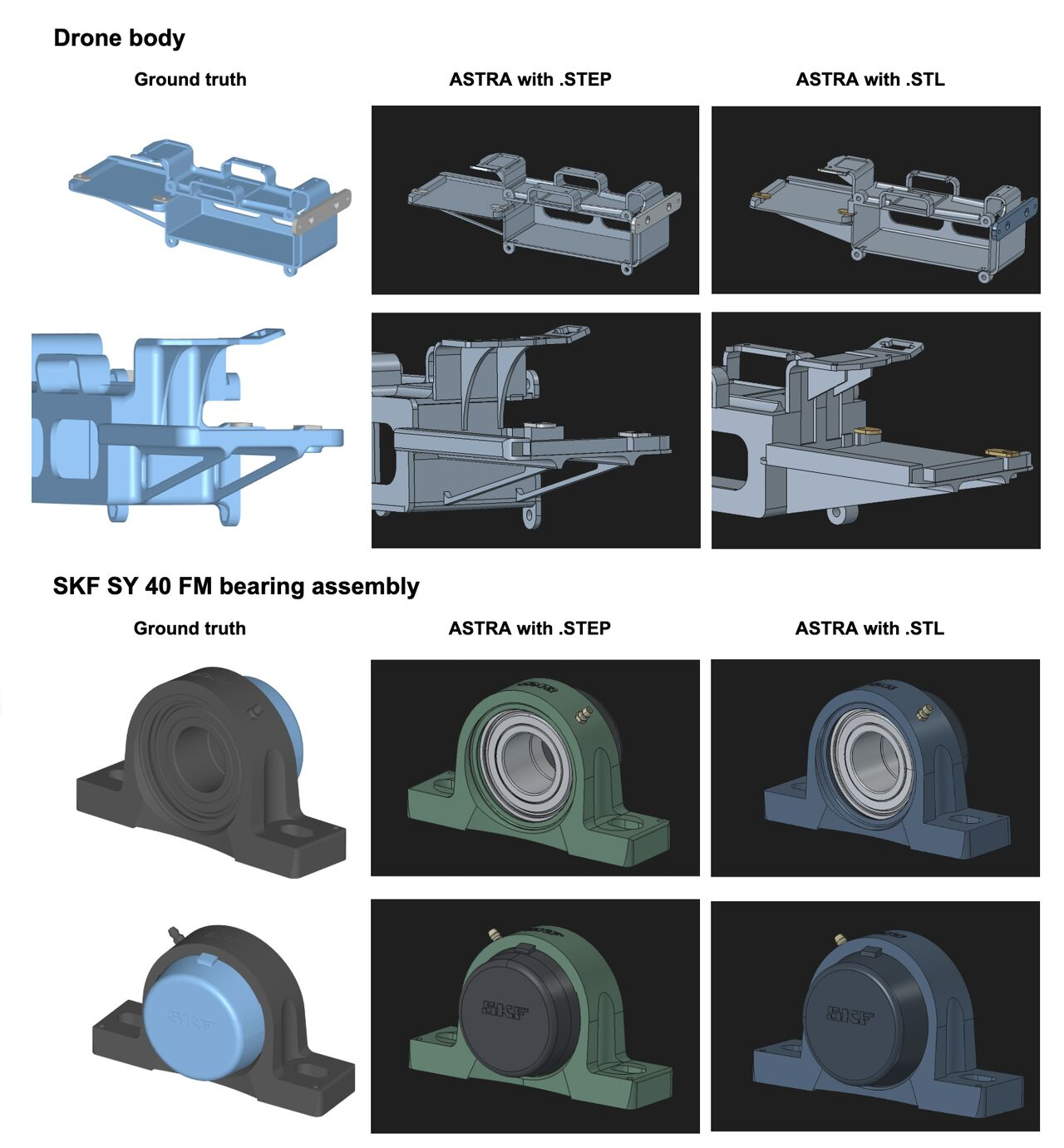
Look closely at the fuel assembly end fitting or the drone body's rib structure. These are not approximations; the slots, fillets, and fastener holes are all there. Either way you feed it, you go from a dumb solid to a parametric model in a real CAD program. That is genuinely impressive.
Has CAD been solved?
We have talked a lot about what AI is good at in CAD. We have also been digging into what it is failing at, and failing hard. So I ran 30 more models through Astra, this time mechanisms rather than static parts, and honestly the results looked really good.
Then I looked a little closer. Almost none of the models that should move had any articulation. Parts interpenetrate, or float in space with nothing holding them. Scissor arms could not pivot about their pin. The conveyor's rollers and belt were welded in place.
This is the gap. Astra is clearly good at making things look right: the surfaces are where they should be and the feature tree is plausible. What it cannot do well yet is assemble them. The constraints that turn a pile of parts into a machine, such as mates, joints, degrees of freedom, and clearances, are missing or wrong. A reconstruction can score 94% on geometric similarity and still be a sculpture of a mechanism rather than a mechanism.
Looks better than it moves
We think this is where the next real step in AI for CAD has to come from. Geometry is a necessary condition, and the frontier labs are closing in on it fast. Kinematics, assembly intent, and functional correctness are a different problem, and the data for it is even scarcer than the data for geometry. We are curious to see who cracks it first. We hope it's us 😉
Has anyone else run into this when using AI for CAD: a really impressive model that looks better than it moves? We would like to hear about it: [email protected].
